
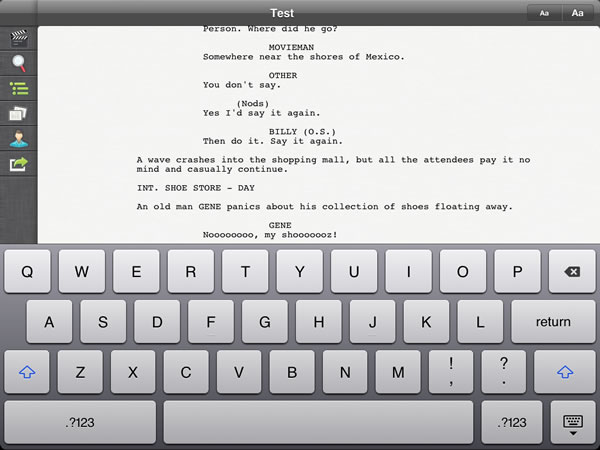
Yes, people are talking about screenplays again. Not just watching films, debating them, ranking them. Actually writing them. Sitting down, opening Trelby, Final Draft, Some random writing app like Scripts Pro, or a Google Doc or a notes app on their phone, and typing INT or EXT for the first time in a while.
It would be easy to dismiss this as a passing aesthetic moment, the screenwriting equivalent of everyone briefly making sourdough or learning to knit during a lockdown. Hobbies surge and recede. But look closer and a more interesting picture emerges: this isn’t one thing. It’s five or six things happening simultaneously, all pointing in the same direction. A genuine, multi-layered renaissance in screenplay culture — driven by forces that range from Hollywood economics to labor history to the anxious, electric energy of the AI age.
The Feature Is Back From the Dead
To understand why this moment feels significant, you have to understand how thoroughly the feature film had been written off — and how that happened in the first place.
The story starts with Netflix, Hulu, Amazon, and the streaming wars they ignited. When these platforms arrived with serious money and serious ambition, they didn’t just change how audiences watched television. They changed where writers wanted to work. Suddenly there was more prestige TV being made than at any point in history, and it needed writers. Good ones. The best ones. Showrunners became the new auteurs. The writers’ room became the destination. And for a long stretch — roughly from the mid-2010s through the early 2020s — the feature film script felt like a relic, a calling card at best, a dead end at worst.
Peak TV had seduced an entire generation of storytellers toward the small screen. And why not? The money was better, the prestige was there, and the form was genuinely exciting — long-arc storytelling, complex characters, room to breathe. Features, meanwhile, felt squeezed from both sides. On one end, franchise blockbusters ate up all the studio oxygen. On the other, streaming content hoovered up the budgets. The original mid-budget feature — the thrillers, the dramedies, the weird little films that somehow got made and somehow found an audience — had been nearly squeezed to extinction.
That calculus has shifted. The streaming boom has matured into a streaming glut. The TV landscape is oversaturated, budgets are under pressure, and the writers’ room that once seemed like the promised land has become a precarious place to build a career. Hollywood has rekindled its appetite for feature spec scripts. Thrillers, horror, romantic comedies — lean, original, producer-friendly material is getting real traction again.
The savviest advice circulating in industry circles right now is remarkably blunt: write something a producer can greenlight without needing sign-off from a tech giant’s board. Write something that can actually get made. That’s a very different energy than the one that prevailed five or ten years ago, and it’s sending working writers — and aspiring ones — back to the blank page with a sense of real possibility. That’s the nice way of looking at it at least.
The Writers Strike Changed Outlooks
You can’t tell the story of this moment without the 2023 WGA strike, which was, among many other things, a forced sabbatical for thousands of working writers. Stripped of their assignments and their rooms, many went back to developing their own material. Spec scripts. Original features. Passion projects that had been sitting in a folder or a drawer for years, waiting for a gap in the schedule that never seemed to come. Some writers discovered, perhaps for the first time in a long time, that they still loved the work for its own sake — not as a gig, not as a deliverable, but as the thing they actually wanted to be doing.
The strike also produced lasting structural protections that have reshaped how writers think about their craft and their careers. The WGA won significant concessions: studios cannot force writers to use AI, and AI-generated content won’t count as “literary” source material when determining credits or compensation. These weren’t just contractual victories. They were a statement — hard-won and legally codified — about what writing is and who gets to do it. That kind of clarity has a galvanizing effect. It reminds people that the work matters enough to fight for. At least it revved them up for a little bit until…
AI Further Changed the Conversation in Ways Nobody Predicted
When tools emerged that could produce passable prose, functional dialogue, and plausible scene description, the reasonable assumption was that writers would feel threatened — and many did. But something else happened too. Writers were forced to articulate, to themselves and to anyone who would listen, what distinguishes a real script from a generated one. What a human perspective actually brings to the page that a language model can’t replicate. What voice is, exactly, when you have to defend it.
The answer, when writers got to it, tended to be surprisingly clarifying. Voice. Specificity. The irreducible weirdness of a particular human consciousness shaping every narrative choice — what to show and what to leave out, which detail to linger on, how a character’s speech pattern reveals something they’d never say directly. These are not things that can be easily systematized or averaged. They are exactly the things that make a script worth reading.
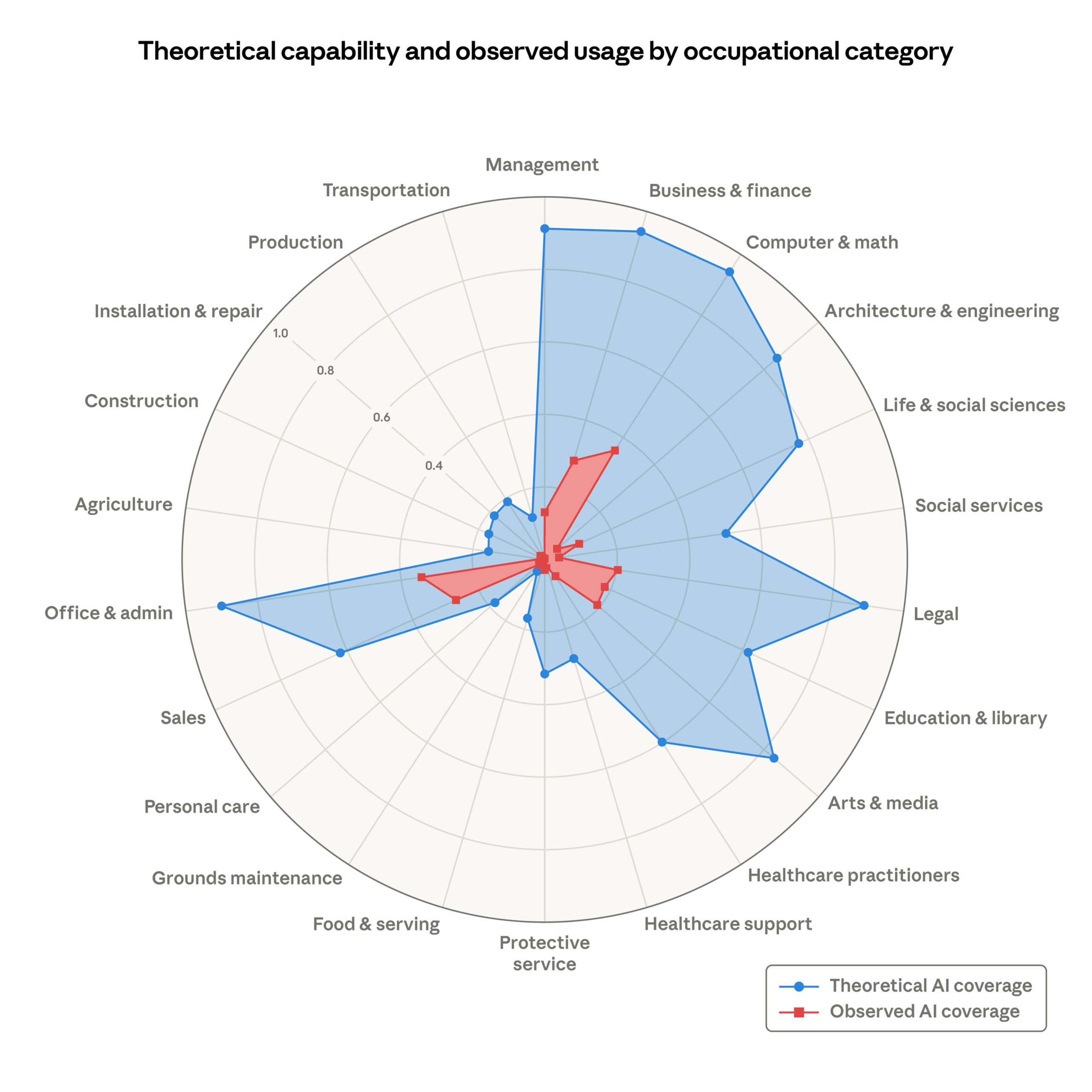
AI anxieties sent a lot of people back to the craft not in retreat, but with something to prove. And that’s a remarkably generative place to write from. And AI seems to know that too. You might think it was for day jobs like admin/office, finance, tech and management, but see this recent study below from Anthropic/Claude. Arts and Media is right up there too. Writers love AI, AI likes writers because it feeds info to AI. But it does not care who gives what to them.
Cinema Is Exciting Again — And That Matters More Than It Sounds
There’s a simpler force at work too, one that’s easy to underestimate: the films themselves. Some have said they are improving in recent years versus the endless recycling drivel. And when films are genuinely good, then more people want to make them. But after years of franchise fatigue and algorithm-driven content, the renewed sense that cinema can still surprise and move and disturb and delight — that it can still be an art form rather than just a delivery mechanism for IP — has had a real and measurable effect on how people are thinking about the work. Its making a comeback…. I’ve been hearing more random people talk about it even on the trains, the street, the city vibe is back?!
The Barriers to Starting Have Never Been Lower
And then there’s the most prosaic explanation of all, which shouldn’t be discounted: it’s simply easier to start than it used to be.
Writing tools are lighter, more portable, and more forgiving than ever. Write up the draft on a tablet. Fade In on a phone. A plain text file with a courier font and some discipline. Free tools like Trelby. The elaborate desktop setup that once felt like a prerequisite has given way to something you can do on the train or in a waiting room or in fifteen minutes before bed. The stigma of drafting on a phone — of treating a small screen as a serious creative tool — has essentially evaporated.
Lowering friction matters. The script that’s been living in your head, or in a half-finished document you haven’t opened in two years, becomes incrementally more likely to actually get written when the barrier to sitting down and continuing it is a little bit lower. Across millions of people, that adds up.
What It All Adds Up To
Taken together, these forces amount to something more than a trend. Closer to a reorientation. The cultural prestige of screenwriting — which had migrated toward television showrunners, then toward auteur directors, then toward whatever the algorithm decided to surface — is spreading back out again. The solo writer, with a spec and a voice and a story they can’t stop thinking about, is finding themselves at the center of the conversation in a way they haven’t been for a while.
Whether any given wave of enthusiasm translates into produced films is, of course, another matter entirely. Hollywood has a long and very specific memory for that particular heartbreak. The pipeline from “person who wrote a screenplay” to “person whose screenplay became a film” remains one of the most brutal in any creative industry. That hasn’t changed.
But the energy is real. The conditions are genuinely favorable in a way they haven’t been for some time. The market wants original material. The culture has rediscovered why it loved cinema. The craft has been publicly defended and legally protected. And the blank page is, as it has always been, waiting.
So if you’ve got a screenplay living in a folder (digital or cardboard analog), or in the back of your mind, or in a notes app you swore you’d return to — this might actually be the moment. Not because success is guaranteed. It never is. But because the world, right now, is paying attention. Barely. And with loads of apps open. And while writing a screenplay.
TL:DR
Writers are a bit slack sometimes and AI helps with that.
Because AI is formulaic and scripts are too, its perceived as a great tool to review your screenplay and find the “gaps” with
Many people are stressed these days and are going for broke, digging out old scripts for AI to tidy up for them (gone are the days of paying for a third party review which was overrated anyway)
AI can write what you can’t be assed to finish.
Writers are screwed and are also screwing themselves with screws.
So do it for yourself, not anyone else, and you may just be ok….